Evaluated for Native Yemeni Plants and Their Use in the Nutrition of Cattle and Buffalo
DOI:
https://doi.org/10.25077/alive.v3.n2.p139-156.2026Keywords:
Alfalfa, buffalo, cattle, leucaena, rhodes grass, sesbania, sorghum, YemenAbstract
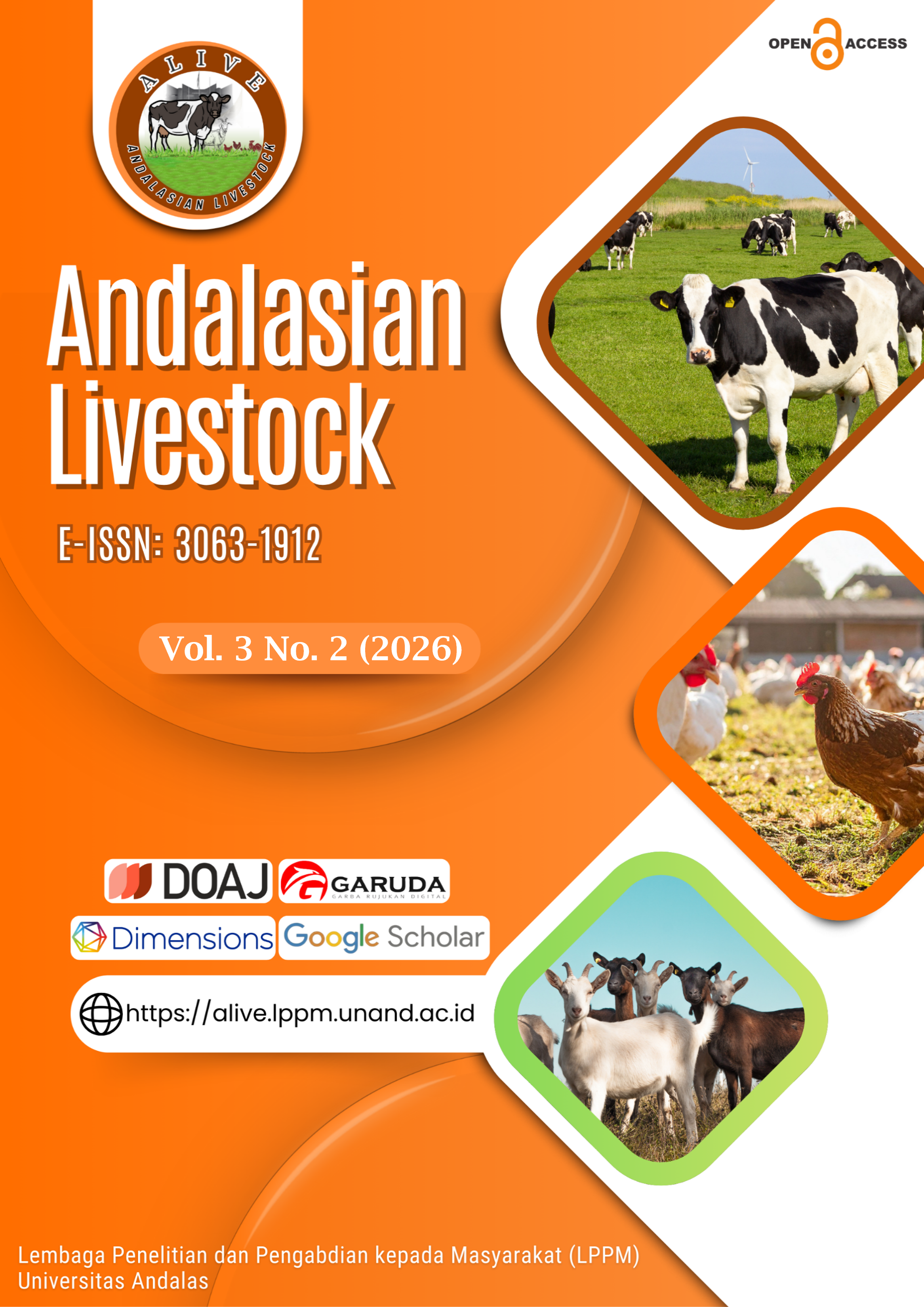
Livestock in the Republic of Yemen is an important national resource and constitutes a fundamental aspect of the agricultural system. It is cared for by finding improved breeds, establishing fattening farms, and providing vaccines and veterinary treatments. Plants are the most important sources of nutrition for animals such as cattle and buffalo. There are two types of plants used as animal feed namely green fodder and concentrated fodder. This research work aims to study five different types of plants grown in Yemen, which have a very significant role in fattening cattle and buffalo. The five plants are Alfalfa (Medicago sativa), Sorghum (Sorghum bicolor), Leucaena (Leucaena leucocephala), Rhodes Grass (Chloris gayana) and Sesbania (Sesbania sesban). The result shows that all the plants in the study grown in Yemen play an important role in fattening cattle and buffalo. It concluded that these natural plants play a significant role in increase the weight as well as milk in the cattle and buffalo.
Downloads
References
Abdelrahman, M. A., Mahgoub, O., & El-Katcha, M. I. (2019). Forage crops and their role in sustainable livestock production. Journal of Agricultural Science, 11(3), 45–58.
Abdelrahman, M. M., El-Hag, F. M., & Babiker, S. A. (2019). Nutritional evaluation of forage crops in arid regions. Journal of Animal Production, 10(2), 45–56.
Ali, A., Khan, M. A., & Mirza, I. H. (2010). Nutritional evaluation of Leucaena leucocephala as forage for ruminants. Animal Feed Science and Technology, 156(1–2), 1–8. https://doi.org/10.1016/j.anifeedsci.2009.11.007
Al-Ashwal, A. A., Al-Hadrami, G. A., & Al-Mahbashi, A. H. (2017). Effect of alfalfa feeding on milk production in dairy cattle under Yemeni conditions. Yemeni Journal of Agricultural Research, 25(2), 45–53.
Al-Ghamdi, A. A., Al-Shaibani, A. M., & Al-Harbi, M. A. (2014). Evaluation of Rhodes grass (Chloris gayana) under arid environmental conditions. Journal of Arid Agriculture, 6(1), 12–20.
Al-Hamdani, M. A., Al-Shaibani, A. M., & Al-Maktari, F. S. (2018). Agroforestry systems and the role of Leucaena leucocephala in improving livestock productivity. International Journal of Agricultural Sustainability, 16(3), 234–245. https://doi.org/10.1080/14735903.2018.1445332
Al-Harazi, A. M., Al-Sakkaf, K. A., & Al-Mashjari, M. S. (2017). Adaptation of Rhodes grass (Chloris gayana) in coastal regions of Yemen. Yemeni Journal of Agricultural Science, 22(1), 67–75.
Al-Harbi, A. R., Al-Ghamdi, A. A., & Al-Shaibani, A. M. (2014). Growth performance and nutritional value of alfalfa (Medicago sativa) under irrigation systems. Agricultural Sciences, 5(9), 789–796. https://doi.org/10.4236/as.2014.59083
Al-Maktari, F. S., Al-Hamdani, M. A., & Al-Shaibani, A. M. (2015). Nutritional evaluation of Leucaena leucocephala as a forage resource in Yemen. Journal of Animal Production Advances, 5(6), 720–728.
Al-Qadhi, A. M., Al-Shamiri, A. M., & Al-Harbi, M. A. (2020). Assessment of rangeland resources and seasonal forage availability in arid regions of Yemen. Journal of Arid Environments, 178, 104165. https://doi.org/10.1016/j.jaridenv.2020.104165
Aregheore, E. M. (2002). Intake and digestibility of tropical forages by ruminants. Tropical Animal Health and Production, 34(1), 45–60.
Bampfylde, C. J., & Waghorn, G. C. (2013). Evaluation of forage quality and animal performance. Animal Feed Science and Technology, 180(1–4), 76–88. https://doi.org/10.1016/j.anifeedsci.2013.02.002
Bennett, J. W., Klich, M., & Pitt, J. I. (2014). Mycotoxins and their effects on livestock health. Clinical Microbiology Reviews, 27(3), 497–516. https://doi.org/10.1128/CMR.00033-13
Chung, C. H., Hwang, B. F., & Wang, S. S. (2004). Effects of mimosine toxicity in ruminants. Journal of Animal Science, 82(3), 123–130.
Devendra, C. (2007). Smallholder livestock systems and food security. FAO.
Elias, E., Seyoum, M., & Tadesse, E. (2008). Nutritional evaluation of alfalfa for dairy cattle. Livestock Research for Rural Development, 20(4), 1–9.
Elgersma, A., & Søegaard, K. (2018). Forage legumes for sustainable agriculture. Agronomy Journal, 110(3), 1–12. https://doi.org/10.2134/agronj2017.05.0272
FAO (Food and Agriculture Organization). (2010). Grassland index: A searchable catalogue of grass and forage legumes. FAO.
FAO (Food and Agriculture Organization). (2013). Climate-smart agriculture sourcebook. FAO.
FAO (Food and Agriculture Organization). (2017). FAOSTAT statistical database. https://www.fao.org/faostat/
FAO (Food and Agriculture Organization). (2018). Feed resources for livestock in developing countries. FAO.
Gutteridge, R. C., & Shelton, H. M. (2003). Forage tree legumes in tropical agriculture. CAB International.
Haruna, U. J., Adebayo, A. A., & Musa, N. N. (2021). Nutritional evaluation of Sesbania sesban and Leucaena leucocephala. Journal of Animal Science and Technology, 63(1), 123–132. https://doi.org/10.1186/s40781-021-00328-9
Hassen, A., Rethman, N. F. G., & Van Niekerk, W. A. (2008). Influence of forage species on ruminant nutrition. African Journal of Range & Forage Science, 25(1), 45–52.
Heuzé, V., Tran, G., Baumont, R., & Lebas, F. (2015). Feedipedia: Animal feed resources information system. INRA, CIRAD, AFZ, FAO.
Jones, R. J. (2000). Effects of mimosine in Leucaena leucocephala. Tropical Grasslands, 34(3), 123–130.
Jung, H. G., Lamb, J. F., Sheaffer, C. C., Samac, D. A., & Jung, H. J. G. (2007). Alfalfa nutritive value and forage quality. Agronomy Journal, 99(2), 365–372.
Kass, M., Rodríguez, R., & Ruiz, R. (2012). Evaluation of fodder trees for livestock feeding. Agroforestry Systems, 85(2), 123–134.
Khan, M. A., Shah, M. A., & Wang, L. (2018a). Role of leguminous forages in sustainable agriculture. Journal of Environmental Management, 213, 1–10. https://doi.org/10.1016/j.jenvman.2018.02.045
Khan, R., Ali, M., & Hassan, M. (2018b). Seasonal variations in forage quality in Yemen. African Journal of Range & Forage Science, 35(4), 251–259.
Khan, N. A., Yu, P., & Ali, M. (2010). Effect of maturity on alfalfa nutritive value. Animal Feed Science and Technology, 157(1–2), 1–10.
Khan, N. A., Yu, P., & Ali, M. (2012). Nutritional evaluation of Sesbania. Animal Feed Science and Technology, 177(1–2), 1–10.
Kumar, R., Singh, M., & Singh, R. (2010). Role of legumes in soil fertility improvement. Journal of Sustainable Agriculture, 34(3), 1–10.
Leng, R. A. (2008). Ruminant nutrition strategies. FAO.
Louhaichi, M., Al-Koor, B., Gamoun, M., Abdurahman, A., & Hassan, S. (2024). Assessment of forage resources in Yemen. Open Life Sciences, 19(1), 1–12. https://doi.org/10.1515/biol-2024-0001
Makkar, H. P. S. (2003). Effects and fate of tannins in ruminants. FAO.
McDonald, P., Edwards, R. A., Greenhalgh, J. F. D., & Morgan, C. A. (2011). Animal nutrition (7th ed.). Pearson.
McDowell, L. R. (2003). Minerals in animal and human nutrition. Elsevier.
Minson, D. J. (1990). Forage in ruminant nutrition. Academic Press.
Mupangwa, J. F., Mapiye, C., & Chimonyo, M. (2017). Nutritional evaluation of forage legumes. Animal Feed Science and Technology, 234, 15–27.
Norton, B. W. (2003). Tree legumes as dietary supplements. In R. C. Gutteridge & H. M. Shelton (Eds.), Forage tree legumes in tropical agriculture (pp. 177–191). CAB International.
NRC (National Research Council). (2001). Nutrient requirements of dairy cattle (7th ed.). National Academies Press.
Ojo, V. O. A., Dele, P. A., & Yusuf, A. O. (2017). Evaluation of sorghum forage. Nigerian Journal of Animal Production, 44(2), 120–130.
Oliveira, J. S., Costa, R. G., & Silva, A. M. (2001). Use of Leucaena in ruminant feeding. Livestock Research for Rural Development, 13(4), 1–8.
Oluremi, O. I. A., Ngi, J., & Andrew, I. A. (2017). Nutritional value of sorghum forage. Animal Feed Science, 230, 123–130.
Ong, C. K., Black, C. R., & Wilson, J. (2004). Tree-crop interactions in agroforestry systems. CAB International.
Owen, E., Kitalyi, A., Jayasuriya, N., & Smith, T. (2005). Livestock and wealth creation. Nottingham University Press.
Poppi, D. P., & McLennan, S. R. (1995). Protein and energy utilization. Journal of Animal Science, 73(1), 278–290.
Preston, T. R., & Leng, R. A. (2009). Matching livestock systems with resources. FAO.
Reed, J. D. (2001). Effects of tannins on nutrition. Journal of Range Management, 54(2), 122–129.
Sapkota, I. P., Shrestha, B., & Gurung, N. (2008). Nutritional value of Sesbania. Livestock Research for Rural Development, 20(3), 1–10.
Van Soest, P. J. (2006). Nutritional ecology of the ruminant. Cornell University Press.
Wanapat, M. (2009). Ruminant nutrition strategies. Asian-Australasian Journal of Animal Sciences, 22(2), 164–172.
Yemeni, A. A., Al-Hadrami, G. A., & Al-Ashwal, A. A. (2020). Water management and productivity of alfalfa. Agricultural Water Management, 240, 106–115. https://doi.org/10.1016/j.agwat.2020.106315
Zhang, J., Liu, X., & Wang, Y. (2025). Anti-nutritional factors in sorghum. Animals, 15(3), 328. https://doi.org/10.3390/ani15030328
Downloads
Published
How to Cite
Issue
Section
License
Copyright (c) 2026 Hassan Pyar, Sharf A. Almcdee, Buthaina F. Bahian, Hana O. Bayashoot

This work is licensed under a Creative Commons Attribution-NonCommercial-ShareAlike 4.0 International License.